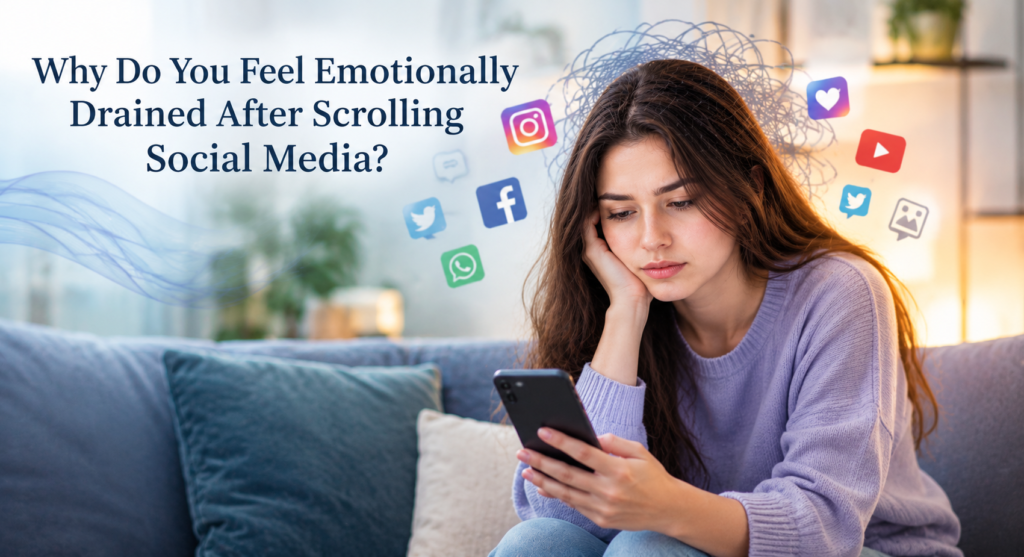
You Open Social Media to Relax, So Why Do You Feel Worse Afterwards?
You have a few minutes to yourself, so you open Instagram, Facebook, YouTube Shorts or another social media platform. You tell yourself that you will scroll for just a few minutes.
One video becomes another. Then you see someone’s holiday photographs, a friend’s achievement, a news story, an upsetting post and several advertisements. You continue scrolling without really knowing what you are looking for.
Eventually, you put your phone down.
But instead of feeling relaxed, you feel strangely tired.
Maybe you feel irritated, distracted, low, anxious or emotionally empty. Sometimes you may not even understand why you feel this way.
If this sounds familiar, you are not alone. Researchers have described a phenomenon known as social media fatigue, which can involve tiredness, frustration, exhaustion, loss of interest and reduced motivation related to social-media use. A systematic review of 40 studies found that information overload and other individual, relational and environmental factors can contribute to this experience.
The important point is that social media itself is not necessarily harmful. It can help people communicate, find support, learn new things and stay connected. The concern is more about how we use it, what we are exposed to and how our minds respond to that experience.
Your Brain May Be Processing More Than You Realise
Scrolling can look like a passive activity, but your mind is constantly receiving information.
One post shows someone’s success. Another discusses relationships. The next contains disturbing news. Then you see a product advertisement, a political opinion, a personal story or a short video designed to hold your attention.
Your brain is continuously interpreting images, words, emotions and social signals.
This can create information overload.
Research has found that information overload, social overload, communication overload and other aspects of social-media use can be associated with exhaustion. A 2025 meta-analysis specifically identified these different forms of social-media overload and found relationships with exhaustion and problematic use.
So when you say, “I only scrolled for 20 minutes,” the experience may still have involved a considerable amount of mental stimulation.

The Comparison Trap Can Quietly Affect Your Mood
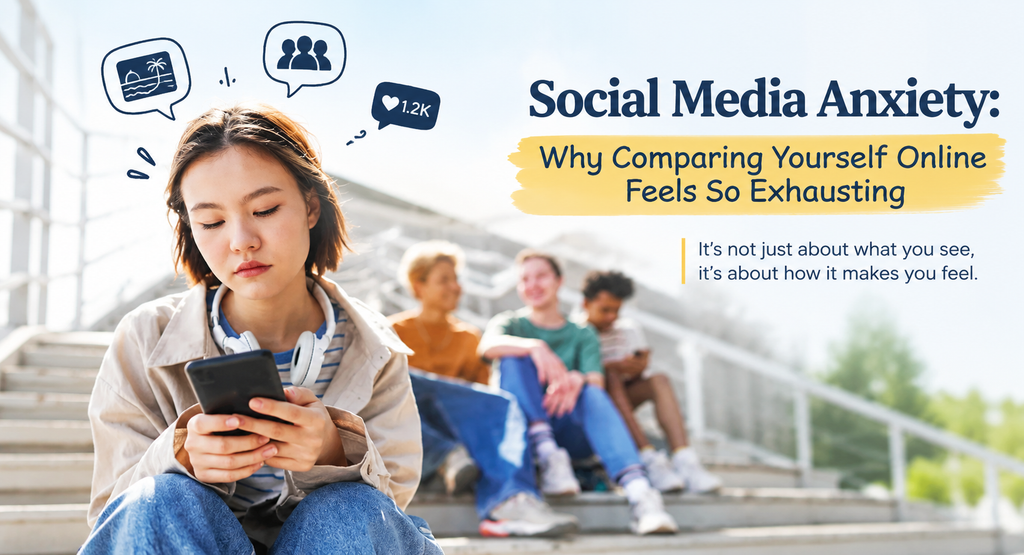
One of the most emotionally demanding aspects of social media is comparison.
You may see someone getting married while you are single. Someone is travelling while you are working. Someone has received a promotion while you are struggling with your career. Someone appears confident, successful and happy while you are having a difficult week.
You know, logically, that social media does not show someone’s entire life.
Yet emotions do not always follow logic.
Repeated exposure to carefully selected images can create the impression that other people are constantly moving forward while you are somehow falling behind. Research on Instagram and mental health has found that exposure to upward-comparison content can have negative effects on well-being.
The problem is not necessarily one particular post.
It is the repeated comparison.
Over time, you may start asking yourself questions such as, “Why am I not doing enough?” or “Why doesn’t my life look like that?”
And those thoughts can leave you emotionally exhausted.
Sometimes You Are Not Comparing Yourself — You Are Absorbing Other People’s Emotions
Social media can also expose you to the emotions of hundreds of people in a very short period.
Someone is angry.
Someone is grieving.
Someone is celebrating.
Someone is frightened.
Someone is arguing.
Someone is sharing disturbing news.
Your mind moves from one emotional environment to another without having enough time to process each one.
This can be particularly difficult when your own emotional reserves are already low.
Recent research has also examined the relationship between exposure to distressing social-media content and emotional exhaustion, anxiety and other psychological outcomes.
This doesn’t mean you need to avoid every difficult story.
Being informed and staying connected can be valuable.
But constantly consuming emotionally intense content without taking breaks can leave you feeling overwhelmed.
Doomscrolling Can Keep You Stuck in a Negative Cycle
Have you ever opened social media because you were bored and then found yourself reading one negative story after another?
You know the content is making you uncomfortable.
You still continue.
This behaviour is often described as doomscrolling – repeatedly consuming negative or distressing online content.
A 2026 scoping review found that doomscrolling is commonly characterised by compulsive consumption of negative content and is associated in existing research with anxiety, depression, stress and reduced resilience. The researchers also noted that much of the current evidence is cross-sectional, so these associations should not automatically be interpreted as proof of cause and effect.
Sometimes we continue scrolling because we are looking for certainty.
We want to know what happened.
We want another update.
We want to understand what comes next.
But the next post rarely provides the reassurance we are looking for.
Instead, it often creates another question.
Why Do You Feel Tired Even When You Were “Just Sitting”?
Emotional exhaustion is different from physical tiredness.
You may not have walked long distances or done strenuous physical work, yet your mind can still feel depleted.
Social-media use can involve constant attention switching, information processing, emotional reactions and social evaluation.
Research examining social-media fatigue has found that emotional exhaustion can act as an important pathway between negative social-media experiences and fatigue. Information overload, system overload and concerns such as privacy or cyberbullying have all been studied as possible contributors.
This helps explain why you can spend an evening scrolling and still feel like you need a break afterwards.
Your body was resting.
Your mind wasn’t necessarily resting.
Not Everyone Who Uses Social Media Will Experience These Effects
It is important not to treat social media as automatically harmful.
The relationship between social media and mental health is complicated. A systematic review and meta-analysis published in 2024 found that problematic social-media use had more consistent associations with depression, anxiety and poorer well-being than social-media use in general.
Similarly, recent research involving adolescents found that problematic social-media use showed more consistent associations with internalising problems than simply the number of hours spent online.
This means that asking only, “How many hours do you spend on social media?” may not tell the whole story.
A more useful question can be:
“How does social media make me feel?”
If you regularly feel anxious, inadequate, emotionally drained or unable to stop scrolling, your relationship with social media may deserve some attention.
How Can You Make Scrolling Feel Healthier?
You don’t have to delete every social-media application.
Instead, start by becoming more intentional.
Notice what happens before you open an app. Are you bored? Lonely? Stressed? Avoiding something? Looking for reassurance?
Understanding the reason behind the behaviour can be more useful than simply telling yourself to stop.
You can also make your feed more comfortable by unfollowing accounts that consistently make you feel inadequate, anxious or emotionally exhausted. Follow content that genuinely interests you, educates you or leaves you feeling positive.
Another simple step is to create small phone-free periods during the day. Try eating a meal without scrolling, taking a walk without checking your phone or keeping your phone away for the last part of your evening.
Most importantly, notice what happens after you scroll.
Do you feel connected?
Inspired?
Calm?
Or do you feel tired, irritated and emotionally empty?
Your answer can tell you a lot.
When Should You Seek Professional Support?
Feeling emotionally drained after scrolling does not automatically mean that you have a mental-health disorder.
However, if you are regularly experiencing low mood, anxiety, excessive worry, sleep difficulties, irritability, loss of interest, loneliness or emotional exhaustion, it may be worth discussing your concerns with a mental-health professional.
If social-media use is becoming difficult to control or is interfering with your relationships, work, studies, sleep or everyday functioning, professional guidance can also be helpful.
If you are searching for the Best Psychiatrist In Indore, Dr. Samhita Bhushan provides compassionate and individualized psychiatric care. She holds an MBBS and MD in Psychiatry and has more than 15 years of experience in psychiatry and mental healthcare, along with professional experience as an Ex-Army Physician.
Her approach focuses on understanding the individual behind the symptoms and providing appropriate support for concerns related to anxiety, stress, mood, sleep, emotional well-being and other psychiatric concerns.
Seeking professional help does not mean that you have to stop using social media.
It means understanding your mental well-being better and learning healthier ways to manage what may be affecting you.
You Don’t Have to Quit Social Media to Protect Your Mental Health
Social media is now part of everyday life.
It can help us stay connected with people we love, discover useful information, express ourselves and find communities where we feel understood.
The goal is not necessarily to disconnect completely.
The goal is to develop a healthier relationship with the digital world.
The next time you finish scrolling and feel emotionally drained, pause for a moment.
Ask yourself:
What did I just consume?
How did it make me feel?
Was I actually relaxing, or was I simply distracting myself?
Sometimes, the answer may surprise you.
Your mental health does not require you to disappear from the online world.
It may simply require you to become more selective about what you allow into your mental space.
And if social-media-related stress, anxiety, loneliness or emotional exhaustion is becoming a regular part of your life, speaking with the Best Psychiatrist In Indore can help you understand your experience and explore appropriate support.
A Few Minutes of Scrolling Shouldn’t Cost You Your Peace
You deserve to put your phone down without feeling emotionally exhausted.
You deserve to enjoy other people’s happiness without questioning your own life.
You deserve to stay informed without becoming overwhelmed.
And you deserve moments when your mind is not constantly consuming something.
Social media can be a part of your life.
It does not have to occupy all of your mental space.
Sometimes, the healthiest scroll is the one you decide to stop.
Frequently Asked Questions
Why do I feel emotionally drained after using social media?
Social media can expose you to large amounts of information, social comparison, emotional content and constant attention shifts. For some people, this can contribute to social-media fatigue and emotional exhaustion.
Is scrolling social media bad for mental health?
Not necessarily. Social media can provide connection, information and support. However, problematic or excessive use has been associated with poorer well-being in research, and individual experiences vary.
Why does social media make me compare myself with others?
Social platforms often show selected moments from people’s lives. Repeated exposure to achievement, appearance and lifestyle content can encourage upward social comparison, which may negatively affect well-being for some people.
What is doomscrolling?
Doomscrolling refers to repeatedly consuming negative or distressing online content, often for longer than intended. Emerging research has associated it with anxiety, stress, depression and reduced resilience, although more research is needed to establish causal relationships.
When should I consult a psychiatrist?
If emotional exhaustion, anxiety, low mood, loneliness, sleep difficulties or excessive social-media use begins affecting your daily functioning, relationships, studies or work, professional support may be helpful.
About Dr. Samhita Bhushan
Major (Dr.) Samhita Bhushan, MBBS, MD (Psychiatry) is a Psychiatrist in Indore and an Ex-Army Physician with more than 15 years of experience in psychiatry and mental healthcare. Her approach emphasizes compassionate, confidential and individualized care.
She supports individuals experiencing concerns related to anxiety and stress, mood, sleep, emotional well-being, relationship and life challenges, and other psychiatric concerns.
Mental health is not about avoiding every source of stress. It is about understanding your experiences, recognising when something is affecting your well-being and seeking appropriate support when you need it.